
If AI does the junior work, who becomes senior?
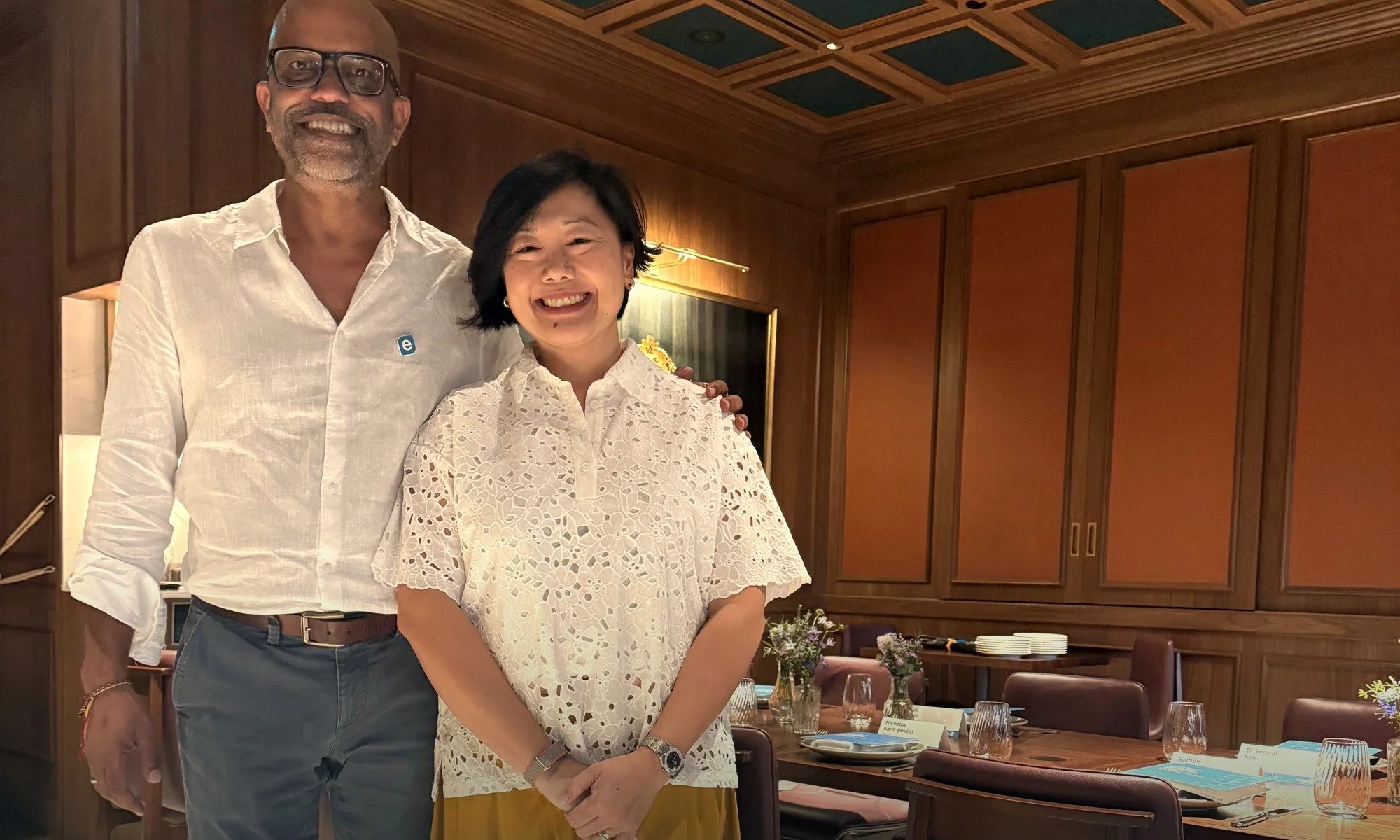
We invited Dr Serene Koh from Singapore's Behavioural Insights Team (BIT) to join a group of business leaders for our latest CAPITAL-e Marketing Roundtable. The conversation was meant to be about AI adoption, but it turned into something closer to a masterclass in human nature.
Most organisations talk about AI adoption in the language of tools and training. Serene, a behavioural scientist, talks about it the way she'd talk about any change, through what actually makes people do things differently. Here's what stuck with us.
1. The Real Barrier Isn't Skills, It's Identity
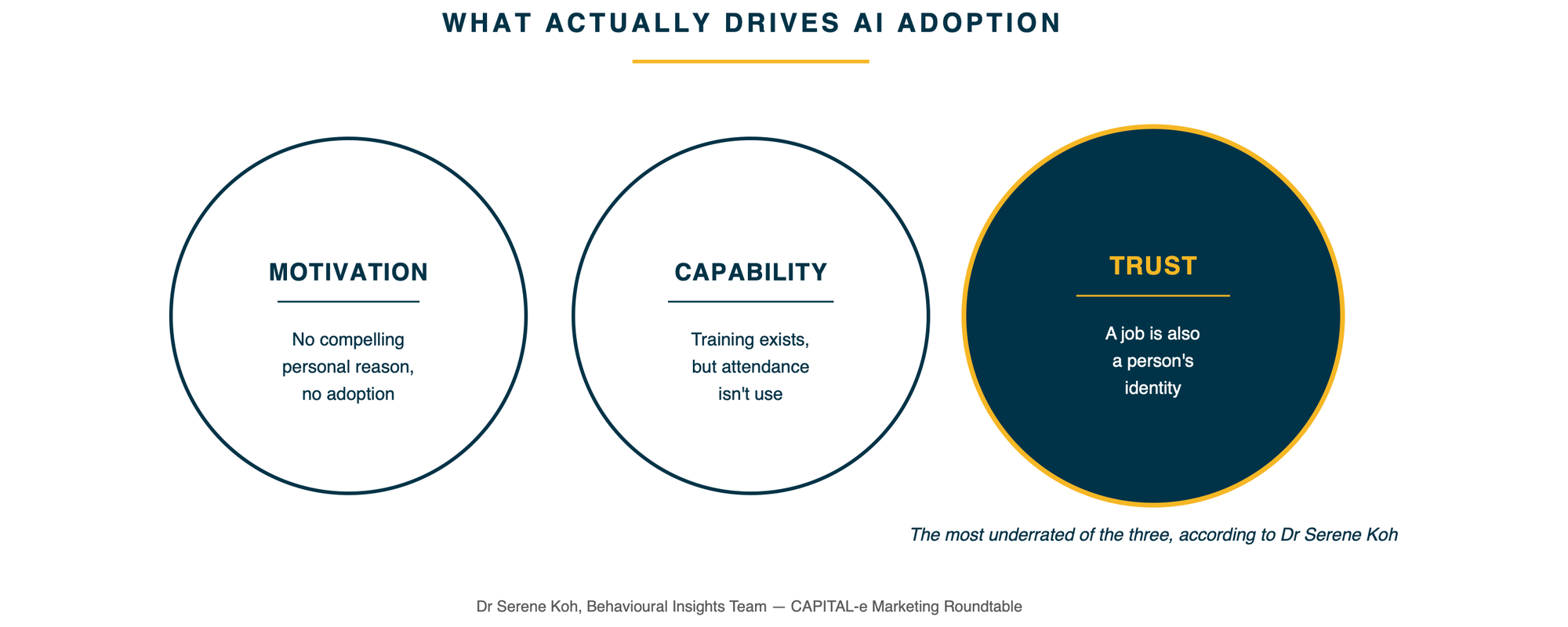
Singapore has poured money into AI skilling grants, and people turn up to the sessions, so attendance isn't the problem, use is. Serene's framework centres on motivation, capability and trust, and in her experience trust is the one everyone underrates. A job is also a person's identity, she said, so the fear isn't just about losing work, it's about whether what you contribute as a person still matters. That's not something you can fix with a training module.
2. If It Adds Work, People Won't Use It
Outside Marina Bay MRT, there's a covered walkway connecting two points about 400 metres apart, and commuters routinely ignore it, cutting across the grass and climbing a fence instead. It's a desire path, the route people actually take when the official one asks too much of them. AI tools run into the same problem when they quietly add verification or learning burden on top of the job someone's already doing. It doesn't matter how capable the tool is. If it makes the job harder before it makes it easier, people will find the fence.
3. Sell It as a Sparring Partner, Not a Replacement
How AI gets pitched internally matters more than most organisations realise. Frame it as something that does the work for people, and it triggers the identity threat described above. Serene's own approach is different: she treats AI as a sparring partner, "a coach, not a crutch," something that sharpens her thinking rather than replacing it. She flagged a risk on the flip side too, what she calls "vanillarisation," when everyone uses the same model the same way and the distinctiveness gets sanded off the output. The tool isn't the problem, using it without a point of view is.
4. People Follow People, Not Policies
Serene cited a study of doctors who were over-prescribing antibiotics. Telling them to prescribe less changed nothing. Telling them they were in the minority, that most of their peers prescribed less than they did, changed behaviour immediately and for good. The catch is that it only works if it's true, because fabricated norms unravel the moment someone realises they've been nudged with a lie, and the trust cost is bigger than the behavioural gain.
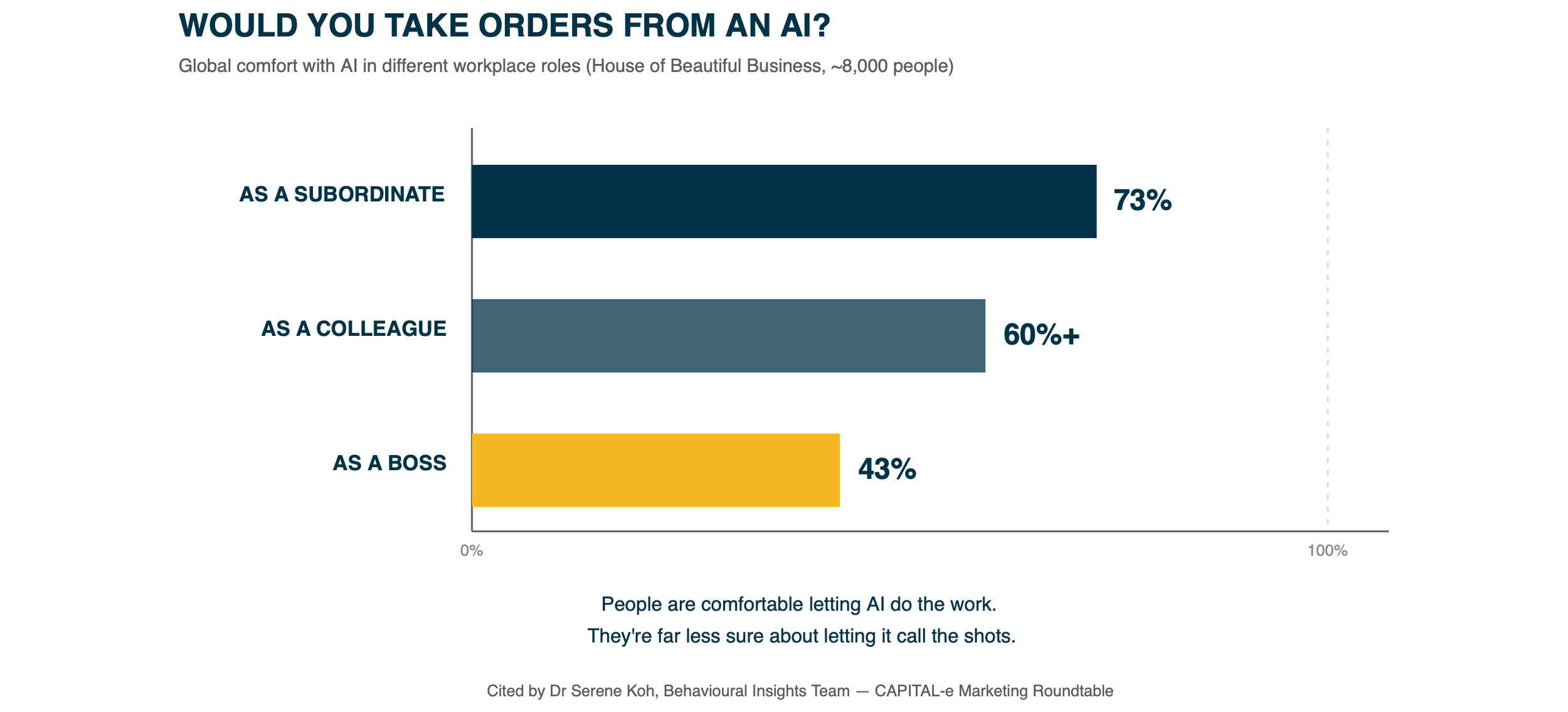
One stat from a global survey Serene shared summed up the trust gap neatly. Around 8,000 people were asked how comfortable they'd be working alongside AI in different roles. Most were fine with it doing the work. Far fewer wanted it calling the shots.
5. "Already Polished by Claude" Is a Management Problem
This idea sparked the most debate around the table. Serene named three risks she sees in workplaces right now: miss-skilling, deskilling and never-skilling. Junior staff who skip the unglamorous parts of a job never build the judgement they'll need later, and her line on it has stuck with us since:
“If you’ve never written a bad email, how do you know how to write a good one?”
Managers used to catch errors and turn them into teaching moments, but when everything arrives pre-polished, the mistakes just move somewhere less visible. The outcomes aren't equal either. People with enough domain knowledge to spot an AI's errors get sharper, because they're still doing the checking, while people without that grounding simply absorb whatever the model gives them as correct, growing more confident and less accurate at the same time. Her fix was refreshingly simple: ask people to show their working, the way maths teachers grade the process and not just the final answer. It's also a pipeline problem hiding behind a productivity win: skip enough of those reps, industry-wide, and "just hire senior people" stops being a strategy and starts being a bet that someone else trained them.
There was more we couldn't fit here, including her read on why Asia is outpacing the West on adoption and her advice to leaders to skip the "we're all in this together" platitudes in favour of being concretely honest about what AI can and can't do in each specific role.
What stayed with us most was the theme running underneath all of it: adoption isn't a technology rollout, it's a trust exercise. And trust, like most of what we care about at CAPITAL-e, isn't built through a mandate or a memo. It's built in the room, in conversation, with people hearing it directly from someone they trust.
A big thank you to Dr Serene Koh for such a thought-provoking session, and to everyone who joined us around the table.
If you'd like to join us at a future CAPITAL-e Marketing Roundtable, or have a conversation you think we should be hosting, we'd love to hear from you.